Examples
DFAs
Example 1
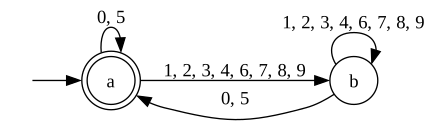
Recognises the language of words over the alphabet {0, .., 9} which are divisible by 5 (end in 0 or 5 or are empty)
Taken from: https://www.bookofproofs.org/branches/examples-of-dfa/
from python_fsa.dfa import DFA

a, b = "a", "b"

dfa = DFA(
    alphabet=(1, 2, 3, 4, 5, 6, 7, 8, 9, 0),
    states=(a, b),
    initial=a,
    transitions={
        (a, 0): a, (a, 1): b, (a, 2): b, (a, 3): b, (a, 4): b, (a, 5): a,
        (a, 6): b, (a, 7): b, (a, 8): b, (a, 9): b,
        (b, 0): a, (b, 1): b, (b, 2): b, (b, 3): b, (b, 4): b, (b, 5): a,
        (b, 6): b, (b, 7): b, (b, 8): b, (b, 9): b,
    },
    final=(a,),
)
render(dfa, "assets/dfa_example1.svg")
Example 2
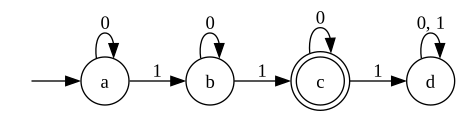
Recognises the language of words over the alphabet {0, 1} which contain exactly two 1s
Taken from: https://www.bookofproofs.org/branches/examples-of-dfa/
from python_fsa.dfa import DFA

a, b, c, d = "a", "b", "c", "d"

dfa = DFA(
    alphabet=frozenset((0, 1)),
    states=frozenset((a, b, c, d)),
    initial=a,
    transitions={
        (a, 0): a,
        (a, 1): b,
        (b, 0): b,
        (b, 1): c,
        (c, 0): c,
        (c, 1): d,
        (d, 0): d,
        (d, 1): d,
    },
    final=frozenset((c,))
)
render(dfa, "assets/dfa_example2.svg")
Example 3
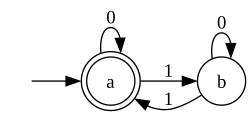
Recognises the language of words over the alphabet {0, 1} which contain an even number of 1s
Taken from: https://www.bookofproofs.org/branches/examples-of-dfa/
from python_fsa.dfa import DFA

a, b = "a", "b"

dfa = DFA(
    alphabet=(0, 1),
    states=(a, b),
    initial=a,
    transitions={(a, 0): a, (a, 1): b, (b, 0): b, (b, 1): a},
    final=(a,),
)
render(dfa, "assets/dfa_example3.svg")
NFAs
Example 1
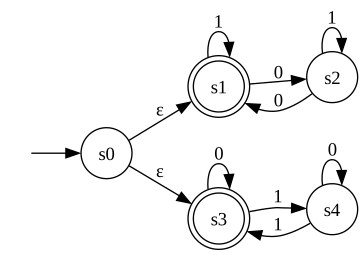
Recognises the language of words over the alphabet {0, 1} which consist of an even number of 1s or 0s
Taken from: https://en.wikipedia.org/wiki/Nondeterministic_finite_automaton#Example_2
from python_fsa.nfa import NFA

s0, s1, s2, s3, s4 = "s0", "s1", "s2", "s3", "s4"
E = NFA.EPSILON

nfa = NFA(
    alphabet=(1, 0),
    states=(s0, s1, s2, s3, s4),
    initial=s0,
    transitions={
        (s0, E): (s1, s3),
        (s1, 0): (s2,),
        (s1, 1): (s1,),
        (s2, 0): (s1,),
        (s2, 1): (s2,),
        (s3, 0): (s3,),
        (s3, 1): (s4,),
        (s4, 0): (s4,),
        (s4, 1): (s3,),
    },
    final=(s1, s3,),
)
render(nfa, "assets/nfa_example1.svg")
Example 2
Recognises the language of words over the alphabet {0, 1} whose second to last symbol is 1.
Taken from: https://www.bookofproofs.org/branches/examples-of-nfa/
from python_fsa.nfa import NFA

a, b, c = "a", "b", "c"

nfa = NFA(
    alphabet=(1, 0),
    states=(a, b, c),
    initial=a,
    transitions={
        (a, 0): (a,),
        (a, 1): (a, b),
        (b, 0): (c,),
        (b, 1): (c,),
    },
    final=(c,),
)
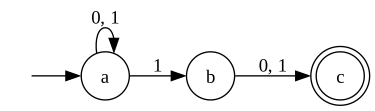
render(nfa, "assets/nfa_example2.svg")
Example 3
Recognises the language of words over the alphabet {0, 1} which are any combinations of the strings 10 and 101
Taken from: https://www.bookofproofs.org/branches/examples-of-nfa/
from python_fsa.nfa import NFA

a, b, c = "a", "b", "c"

nfa = NFA(
    alphabet=(1, 0),
    states=(a, b, c),
    initial=a,
    transitions={
        (a, 1): (b,),
        (b, 0): (a, c),
        (c, 1): (a,),
    },
    final=(a,),
)
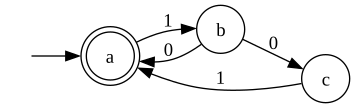
render(nfa, "assets/nfa_example3.svg")