Quick Start
Install
pip install python-fsa
Installation Notes
In order to use the python-fsa render(),
dfa_from_dot(), and
nfa_from_dot() functions, pygraphviz will need to be
installed.
See the PyGraphviz install notes for more information on how to install this.
This is not needed if the aforementioned functions are not needed.
Usage
The two main classes in python-fsa are DFA and
NFA which provide immutable deterministic and
non-deterministic finite state automata respectively.
Each takes an alphabet, states, initial state, transition mapping, and final state. For example, the following dfa recognises the language of words over the alphabet {0, 1} which contain an even number of 1s:
from python_fsa.dfa import DFA

a, b = "a", "b"

dfa = DFA(
    alphabet=(0, 1),
    states=(a, b),
    initial=a,
    transitions={(a, 0): a, (a, 1): b, (b, 0): b, (b, 1): a},
    final=(a,),
)

dfa.accepts((1, 0, 1, 0))  # True
dfa.accepts((1, 1, 1, 0))  # False
Taken from: https://www.bookofproofs.org/branches/examples-of-dfa/
The following NFA recognises the language of words over the alphabet {0, 1} which consist of an even number of 1s or 0s:
from python_fsa.nfa import NFA

s0, s1, s2, s3, s4 = "s0", "s1", "s2", "s3", "s4"
E = NFA.EPSILON

nfa = NFA(
    alphabet=(1, 0),
    states=(s0, s1, s2, s3, s4),
    initial=s0,
    transitions={
        (s0, E): (s1, s3),
        (s1, 0): (s2,),
        (s1, 1): (s1,),
        (s2, 0): (s1,),
        (s2, 1): (s2,),
        (s3, 0): (s3,),
        (s3, 1): (s4,),
        (s4, 0): (s4,),
        (s4, 1): (s3,),
    },
    final=(s1, s3),
)

nfa.accepts((1, 0, 1))  # True
nfa.accepts((1, 0))  # False
Taken from: https://en.wikipedia.org/wiki/Nondeterministic_finite_automaton#Example_2
This NFA features an epsilon transition. By default, the
EPSILON constant is used. If a different object is
wanted for this purpose, epsilon will need to be passed in as a named parameter
in the NFA constructor. Epsilons are compared via equality when NFAs are
constructed so should define __eq__ or be singletons.
Processing NFAs
Epsilon edges can be removed with without_epsilon().
For example:
new_nfa = nfa.without_epsilon()
NFAs can be converted to DFAs with the to_dfa()
method. For example:
new_dfa = nfa.to_dfa()
It is often useful to then squash() the resulting DFA
which converts the sets of states resulting from the transformation to strings.
For example:
new_dfa = nfa.to_dfa().squash()
Now instead of being of type DFA[int, frozenset[str]], the dfa is of type
DFA[int, str] which is often more useful when displaying the resulting DFA.
FSAs and Graphviz
The graph module has many utility functions for turning FSA
to and from graphviz dot language, and rendering FSAs as images.
For Example, using the FSAs from before:
from python_fsa.graph import dfa_from_dot, nfa_from_dot, render, to_dot

# FSA to Graphviz dot code
nfa_dot = to_dot(nfa)
dfa_dot = to_dot(dfa)

# Graphviz dot code to FSA
new_nfa = nfa_from_dot(nfa_dot)
new_dfa = dfa_from_dot(dfa_dot)

# Render FSA as Graphviz diagram
render(nfa, "assets/nfa_example.svg")
render(dfa, "assets/dfa_example.svg")
With the last two commands producing the following images:
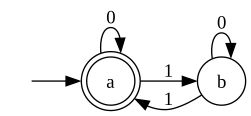
A DFA
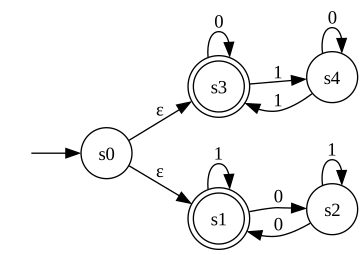
An NFA
Transducers
NFAs and DFAs are immutable, only able to accept or reject an entire string of words. However, FSAs can produce mutable transducers which can take a single word at a time. These transducers are Moore machines that can optionally provide output for each state the transducer is in.
NFAs and DFAs produce python_fsa.nfa.NFATransducer and
python_fsa.dfa.DFATransducer objects respectively and are created with
the python_fsa.nfa.NFA.transducer() and
python_fsa.dfa.DFA.transducer() methods respectively.
For example:
output = {a: "Even #ones", b: "Odd #ones"}
dfa_transducer = dfa.transducer(output)

dfa_transducer.push(1)  # Odd #ones
dfa_transducer.push(0)  # Odd #ones
dfa_transducer.push(1)  # Even #ones
dfa_transducer.push(0)  # Even #ones
dfa_transducer.current  # 'a'
dfa_transducer.is_accepting  # True
dfa_transducer.output  # Even #ones
If no output mapping is given, the default is to return a boolean indicating whether the current state is a final state.
NFAs, will return sets of outputs:
output = {
    s0: "Both Even",
    s1: "Even #Zeros",
    s2: "Odd #Zeros",
    s3: "Even #Ones",
    s4: "Odd #Ones",
}
nfa_transducer = nfa.transducer(output)

nfa_transducer.push(1)  # frozenset({'Odd #Ones', 'Even #Zeros'})
nfa_transducer.push(0)  # frozenset({'Odd #Ones', 'Odd #Zeros'})
nfa_transducer.push(1)  # frozenset({'Even #Ones', 'Odd #Zeros'})
nfa_transducer.push(0)  # frozenset({'Even #Ones', 'Even #Zeros'})
nfa_transducer.current  # frozenset({'s1', 's3'})
nfa_transducer.is_accepting  # True
nfa_transducer.output  # frozenset({'Even #Ones', 'Even #Zeros'})